
The most common mistake growing businesses make isn't a bad hire or a missed market. It's their leader spending 60% of their time on work that was never meant to be on their plate in the first place.
Let's be direct: when most people hear "Executive Assistant," they picture someone answering phones in a Manhattan high-rise, a nice-to-have luxury for the Fortune 500 crowd.
That picture is costing businesses like yours real money, real focus, and real growth.
Because here's what a decade of placing top-tier EAs has taught us: the leaders who scale fastest aren't necessarily the smartest, the most connected, or the best capitalised. They're the ones who figured out (early) that protecting their time and attention is a strategic decision, not an administrative one.
A great EA doesn't answer your phone. They make sure your phone only rings when it should.
Why the myth still exists
Historically, executive support was gatekept by corporate hierarchy. If you weren't a C-suite lifer at a big firm, the assumption was you didn't need, or deserve, that level of support.
That thinking was always wrong. It's just that now, with remote-first teams, leaner businesses, and fractional EA models, it's visibly wrong in a way that's hard to ignore.
Myth: "EAs are for big corporates and busy executives with staff."
Reality: Growing businesses benefit most. When margins are tighter and every hour counts, leverage matters more, not less.
Myth: "I can handle it myself, it's more efficient."
Reality: Every hour you spend on admin is an hour not spent on strategy, client relationships, or growth. The maths doesn't favour doing it yourself.
Myth: "It's a nice-to-have, not a need-to-have."
Reality: If your time has strategic value, and it does, then anything consuming it without producing strategic output is a direct cost to the business.
The real cost of doing it yourself
Leaders who go without EA support don't just absorb more work, they absorb the wrong work. And the compounding effect is significant.
Here's a conservative look at what the "I'll just handle it" approach typically costs:
⏱Hours lost to low-value tasks weekly: 8–15 hrs
📧Avg time spent on email daily: 2.5 hrs
📅Scheduling back-and-forth per meeting: 17 mins
🔥Leaders citing burnout from admin overload: 68%
Now multiply those hours by your effective hourly rate, and by the opportunity cost of strategic work that didn't happen while you were chasing a travel itinerary.
It's not a small number.
The hidden cost nobody talks about: It's not just the time lost — it's the mental load. Context-switching between strategic thinking and operational minutiae is cognitively expensive. Research consistently shows it takes up to 23 minutes to fully re-engage after an interruption. Every calendar conflict, every chased invoice, every forgotten pre-read is a tax on your best thinking.
What a great EA actually does (and doesn't do)
This is where we need to be precise, because the gap between a good EA and a great one is the gap between a task-taker and a thought partner.
A great EA operates across three distinct levels:
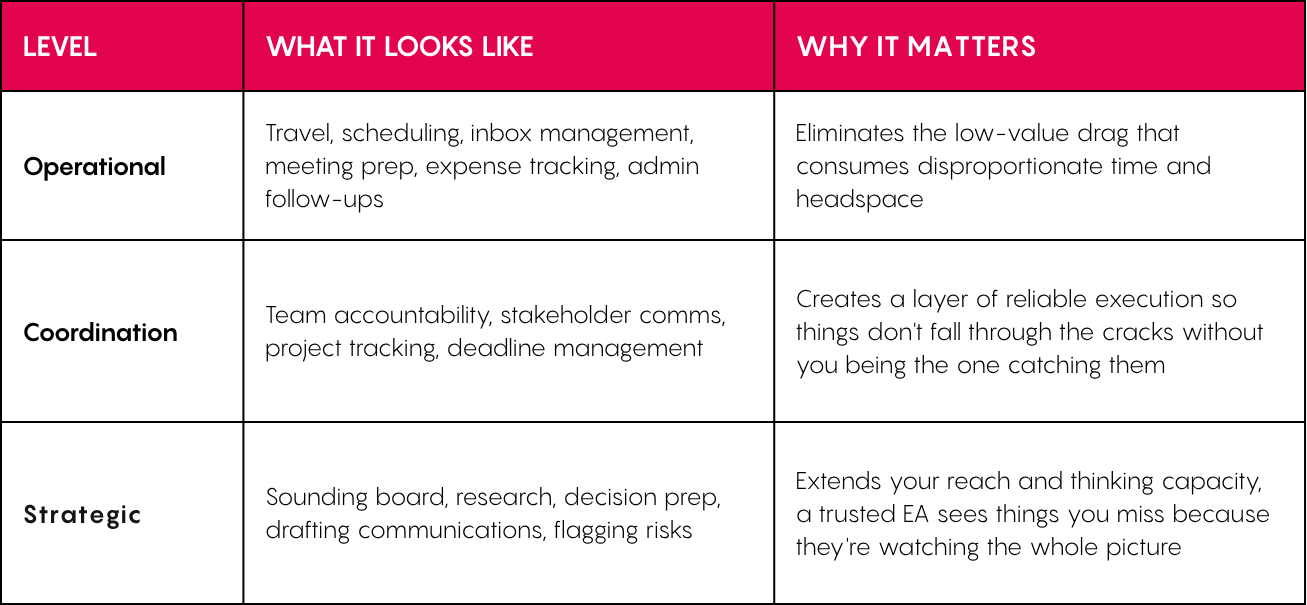
Most people hire for level one. The best EAs operate at all three. The difference isn't just about experience, it's about fit, brief, and how you build the relationship.
"The best leaders don't try to do everything. They get very clear on what only they can do — and build support structures around everything else."
Signs you're ready for an EA (even if you don't feel like it)
In our experience, most leaders who need an EA don't believe they do, until they have one. Here are the signals worth paying attention to:
You regularly miss or scramble for meetings because scheduling is handled reactively, not proactively
Your inbox is a source of anxiety rather than a managed communication channel
You end the day feeling busy but unsure what actually moved forward
Strategic priorities get pushed because operational fires keep taking over
You've started to notice that small, "minor" things are creating outsized stress or embarrassment
Growth feels like it's being bottlenecked by your personal capacity rather than external factors
If three or more of those land, you're not thinking about whether you need an EA. You're thinking about when.
How to set an EA up for success from day one
One of the most common reasons EA relationships underdeliver is a poor onboarding, not a poor hire. The brief is everything. Here's what great leaders do in the first 30 days:
Share context, not just tasks. Let your EA understand your priorities, your communication style, and how you make decisions. The more they understand the 'why', the more autonomously they can act on the 'what'.
Give access early. Calendar, inbox, key contacts, travel preferences. An EA who's operating without full visibility is an EA operating at half capacity.
Establish a daily or weekly check-in. Even 15 minutes keeps alignment tight and builds trust quickly. Feedback loops are how great EA relationships compound over time.
Let them fail small. An EA who's afraid to act without explicit sign-off for every decision will always be reactive. Build in permission to make judgment calls, and debrief when something doesn't land.
The bottom line
Great leadership has never been about doing more. It's about doing the right things, with full attention, full energy, and full strategic focus.
The leaders we see scaling fastest right now are not working harder than everyone else. They've gotten very clear on what only they can do, and they've built the support structures to protect that space relentlessly.
An EA isn't the first hire you make when you've "made it." It's the hire that helps you get there.
If you're still at the stage where you're doing your own scheduling, chasing your own meeting notes, and managing your own inbox while trying to lead a business — the question isn't whether you can afford an EA. It's whether you can afford not to have one.
Ready to find the right EA for your business?
We specialise in setting people just like you up with an exceptional EA who don't just support leaders, they help them scale. Let's talk about what that looks like for you.